

Feeding a global population that is projected to reach ten billion by mid-century while simultaneously reducing agriculture’s environmental footprint is one of the defining challenges of our time. These two objectives can appear to be in tension with each other. Producing more food requires more land, more water, and more inputs. Yet the planet’s capacity to absorb the consequences of intensive agricultural production is not unlimited.
Modern agricultural tractors are playing a more significant role in resolving this tension than many people outside the farming community appreciate. The advances built into today’s tractor platforms are not only making farms more productive. They are making them more responsible.
Precision Technology Reduces Input Waste
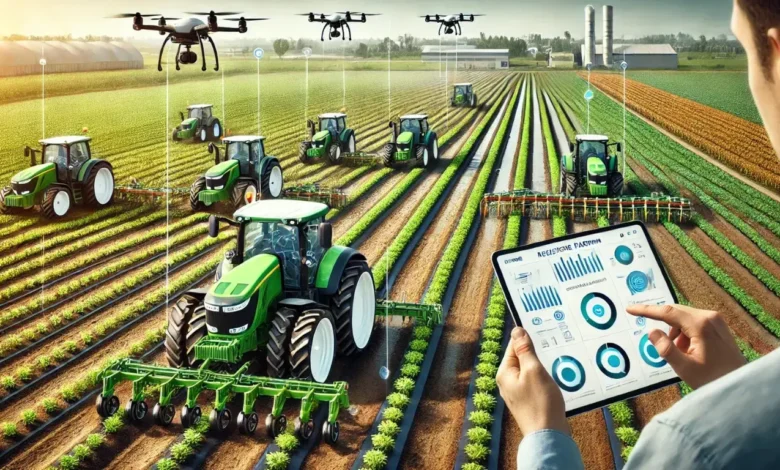
One of the most direct contributions that modern agricultural tractors make to sustainable agriculture is the reduction of input waste through precision technology. GPS-guided steering systems eliminate the overlaps that occur with manual field navigation, ensuring that seed, fertiliser, and crop protection products are applied exactly where they are needed and nowhere else.
Variable rate application technology, increasingly integrated with tractor platforms, takes this further by adjusting application rates in real time based on field-specific data. Areas of the field that need more receive more. Areas that need less receive less. The result is lower input costs for the farmer and lower environmental loading from unnecessary chemical application across the landscape.
For sustainable agriculture to be economically viable rather than simply aspirational, this kind of precision is essential. A farmer who can achieve the same or better yield with less fertiliser and fewer passes across the field is farming both more profitably and more responsibly.
Fuel-Efficient Engines Lower the Carbon Footprint
Modern agricultural tractors are significantly more fuel-efficient than the machines they have replaced. Advanced fuel injection systems, turbocharging, and intelligent engine management extract more work from every litre of diesel, reducing both operating costs and greenhouse gas emissions per hour of field operation.
Across a full cropping season, the cumulative reduction in fuel consumption from running a modern tractor platform compared to an older equivalent is substantial. For farming operations managing large areas or multiple machines, this translates into a meaningful reduction in carbon output without any compromise to field productivity.
The development of alternative powertrain options, including electric and hybrid tractors for compact and utility applications, extends this contribution further. While full electrification of large, high-horsepower agricultural tractors remains a longer-term development, the direction of the industry is clear and the pace of progress is accelerating.
Conservation Tillage and Soil Health
Sustainable agriculture depends fundamentally on healthy soil. Soil that is over-tilled loses its structure, its organic matter content, and its biological diversity. Erosion accelerates. Water retention declines. The land becomes progressively less capable of supporting productive crops without increasing chemical inputs.
Modern agricultural tractors enable conservation tillage practices that protect and restore soil health. Minimum tillage and no-till systems, which disturb the soil as little as possible between crop cycles, are only practical at scale when matched with the right tractor and implement combinations. Precision depth control, consistent hydraulic pressure management, and the power to pull specialised conservation tillage implements across varied soil conditions are all capabilities that modern tractor engineering provides.
Farmers who adopt conservation tillage supported by appropriate tractor technology are simultaneously reducing soil erosion, improving water infiltration, increasing organic matter levels, and reducing their fuel and labour costs. These outcomes align the farmer’s economic interests directly with sustainable land management, which is the most durable basis for lasting change in agricultural practice.
Reduced Labour Dependency and Rural Sustainability
Sustainable food production is not only an environmental question. It is a social one. Rural communities across Asia, Africa, and other farming regions face persistent challenges in retaining agricultural labour as younger generations migrate toward urban employment. A food system that depends on a labour supply that is structurally declining is not sustainable, regardless of how environmentally sound its practices may be.
Modern agricultural tractors address this challenge directly by reducing the labour required per unit of agricultural output. Operations that previously required large teams working across days can be completed by a single skilled operator in a fraction of the time. This does not displace farming communities. It allows them to farm more land, produce more food, and generate more income from the same or smaller working populations.
Mechanised farming supported by modern agricultural tractors is, in this sense, one of the most practical tools available to rural development programmes working to make smallholder and commercial farming economically sustainable across emerging markets.
Building a Food System That Lasts
Sustainable food production requires farming that can continue indefinitely without degrading the resources on which it depends. Modern tractors, through precision technology, fuel efficiency, conservation tillage capability, and labour productivity, are contributing to exactly that kind of farming.
The tractor has always been a tool of transformation in agriculture. Today, the transformation it is enabling is one that the world genuinely needs: more food, from the same land, with a smaller environmental cost, sustained across the generations of farmers still to come.


